
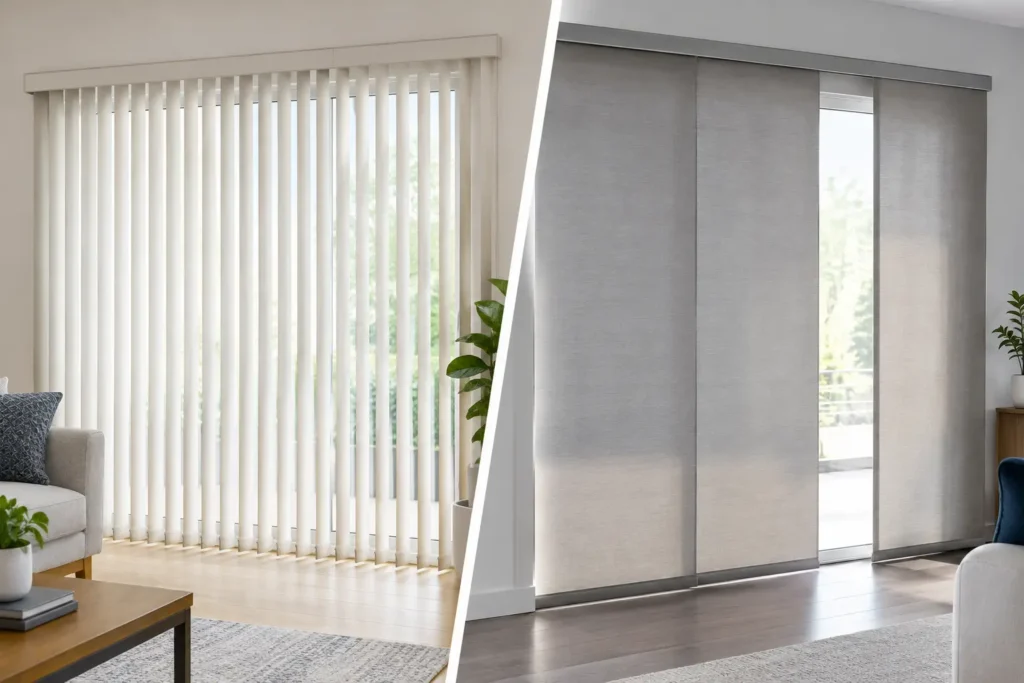
A sliding glass door can be the brightest feature in a room and the hardest window to cover well. It needs privacy at night, glare control during the day, and a treatment that does not fight the way people move in and out. When comparing vertical blinds versus panel tracks, the better choice usually comes down to how you use the opening, the room’s style, and how much visual structure you want around the glass.
Both options are designed for wide windows and patio doors, and both travel side to side rather than lifting from the bottom. That shared purpose can make them seem interchangeable. In practice, they create very different looks and operate differently day to day. A custom measurement and a look at the actual room can make the decision far clearer than a sample photo ever could.
How vertical blinds and panel tracks work
Vertical blinds use individual vertical vanes attached to a headrail. The vanes rotate to fine-tune incoming light and privacy, then stack to one or both sides when the door or window needs to be fully open. They are available in vinyl, fabric, faux wood-look materials, and other finishes, giving homeowners a wide range of price points and appearances.
Panel track blinds use broad fabric or woven panels that slide along a track. When open, the panels stack behind one another in a clean, compact group. When closed, they form a flat, tailored surface across the opening. Rather than rotating like vertical blind vanes, panel tracks generally adjust light by moving the panels open or closed.
The distinction matters most in everyday use. Vertical blinds offer more incremental control. Panel tracks offer a more architectural, simplified presentation.
Vertical blinds versus panel tracks for style
Vertical blinds have come a long way from the basic styles many people remember. With carefully selected materials and colors, they can look crisp and purposeful in a kitchen, family room, rental property, or office. They also work especially well in rooms that already have blinds on nearby standard windows, creating a consistent visual language without forcing every opening into the same product.
Their individual vanes add rhythm to a wide expanse of glass. That can be a benefit in practical, traditional, or transitional spaces, where some visible structure feels appropriate. Textured fabric vanes can soften the effect, while smooth vinyl is often a sensible choice for high-traffic doors and areas where easy cleaning matters.
Panel tracks tend to suit contemporary, modern, and relaxed California interiors. Their wider panels create fewer vertical lines, so the treatment reads more like a designed wall covering when closed. Woven textures, solar screen materials, and soft fabric options can add warmth without making the room feel busy.
For a minimalist room with clean-lined furniture, panel tracks are often the stronger visual choice. For a space where durability, adjustability, and value lead the conversation, vertical blinds frequently earn their place. Neither is automatically more attractive. The right one is the treatment that supports the home rather than asking for attention.
Consider what the treatment looks like when it is open
This detail is easy to overlook. A vertical blind stack is made up of many narrow vanes, while panel tracks stack in wider sections. If your patio door has limited wall space on the side where the treatment needs to stack, the available clearance should be evaluated before selecting either option.
For a large opening, panel tracks can sometimes create a more composed stack because there are fewer, broader panels. On the other hand, a vertical blind configuration may be more flexible when a door opens from one side and the treatment needs to draw away from that traffic path. Professional measuring helps determine the best stack direction, overlap, and mounting position.
Light control and privacy are not identical
The strongest functional advantage of vertical blinds is vane rotation. You can angle the vanes to reduce direct sun, cut screen glare, or add privacy while preserving a degree of daylight. That flexibility is valuable on west-facing doors and windows, where the afternoon sun can heat up a room quickly.
When closed, vertical blinds still have small spaces between vanes. High-quality custom products minimize those gaps, but they are not generally a blackout solution. Rotating the vanes can also direct light upward or downward, which makes the room more comfortable without shutting out every bit of natural light.
Panel tracks provide privacy through larger continuous panels. A room can feel more covered and visually calm with the panels drawn, particularly when the fabric is opaque or room-darkening. However, panel tracks do not offer the same degree of light adjustment while remaining fully closed. To bring in more light, you open sections of the track rather than rotate individual panels.
If you want filtered daylight and daytime privacy, solar screen panel fabrics are worth considering. They can reduce glare and UV exposure while maintaining an outward view, though evening privacy will be limited when interior lights are on. If complete darkness is a priority for a bedroom or media room, ask about room-darkening fabrics and the realistic light gaps around any sliding treatment.
Daily use, durability, and cleaning
For a busy patio door, the best treatment is one people can operate without hesitation. Vertical blinds are familiar, straightforward, and well suited to frequent use. Individual vanes can be replaced if one is damaged, which may be useful with pets, children, or active outdoor access. Vinyl styles are also simple to dust or wipe down.
Their trade-off is movement. Open windows or a passing breeze can cause vanes to shift or tap together. This is usually manageable, but it is worth considering for doors that stay open often. Poorly installed vertical blinds can also look uneven or operate roughly, which is why correct headrail placement and careful adjustment matter.
Panel tracks move in broad sections, giving them a quieter and more deliberate feel. Fabric panels should be vacuumed gently with an upholstery attachment or cleaned according to the manufacturer’s instructions. They are not always the best fit for a door that receives muddy paws, sticky hands, or constant contact, although durable fabrics and wipeable materials are available.
Because panel track panels overlap, they should glide smoothly without catching or bunching. Accurate track sizing, mounting depth, and panel alignment are essential. A custom installation also prevents common issues such as dragging panels, a track placed too close to the door handle, or incomplete coverage at the sides.
Cost and customization for wide openings
Cost depends on opening size, material, operating system, and installation conditions. Vertical blinds are often the more budget-friendly custom option, particularly in vinyl. Fabric vertical blinds and upgraded headrails move the price upward, but they can still be a practical investment for broad openings.
Panel tracks often cost more because of their wider panels, fabric selections, and track systems. They can be especially worthwhile when the treatment is a major design feature in a remodeled living room, primary bedroom, office, or open-plan space. Motorized operation may be available for select configurations, adding convenience for oversized or hard-to-reach windows.
Customization matters more than a quick price comparison. A stock treatment may not account for uneven walls, trim depth, door handles, floor clearance, or the direction your door operates. The goal is a finished look that covers the glass properly and functions comfortably for years.
Which option fits your room?
Choose vertical blinds when you want adjustable light control, easy maintenance, replaceable individual vanes, and a cost-conscious solution for a heavily used sliding door. They are a dependable choice for homes, offices, and rental properties where function needs to stay front and center.
Choose panel tracks when you prefer wide, clean fabric panels and a more contemporary appearance. They are particularly effective over large glass walls, expansive windows, and patio doors in rooms where texture, color, and a tailored finish are part of the design plan.
There are also situations where the answer is not either-or. A room with intense afternoon sun may benefit from a different shade material entirely. A narrow door with very limited stacking space may call for another configuration. That is why seeing samples against your flooring, paint, daylight, and furnishings is so useful.
For Los Angeles and Orange County homeowners, a free in-home consultation with Blinds by Design makes it possible to compare materials, colors, and operating options where they will actually be used. Bring a few photos or inspiration ideas, then let the door’s traffic pattern, the light in the room, and the finish you want guide the final choice.