
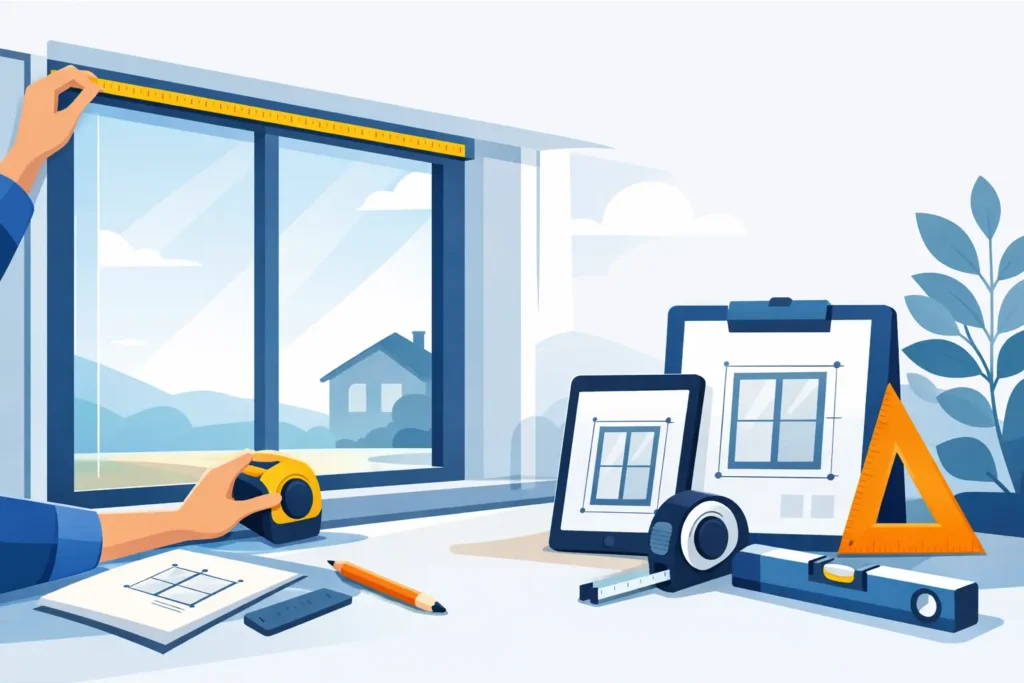
A window can look perfectly square from across the room and still vary by a half-inch from top to bottom. That small difference can affect how blinds raise, how shades stack, whether shutters clear the trim, and how polished the finished room feels. This guide to custom window measurements explains what must be considered before ordering window treatments, as well as when professional measuring is the smarter choice.
Custom treatments are designed for the opening they will cover, not for a standard-size window on a store shelf. For Los Angeles and Orange County homeowners, that matters in older homes with uneven plaster, remodeled spaces with new trim, wide sliding doors, or windows set close to a wall or corner. Accurate measurements are the foundation for privacy, light control, smooth operation, and a tailored appearance.
Start With the Mount Type
The first measurement is not a number. It is a decision: will the treatment be mounted inside the window opening or outside it? The answer influences every dimension that follows.
An inside mount sits within the window frame or recess. It creates a clean, built-in look and keeps the surrounding trim visible. Inside-mounted cellular shades, roller shades, wood blinds, and certain shutters can work beautifully when the opening is deep enough and reasonably square. The trade-off is that small light gaps remain at the sides, and the hardware needs adequate mounting depth.
An outside mount is installed on the wall, trim, or molding above and around the opening. This choice is often helpful when the frame is shallow, the opening is uneven, or stronger room darkening and privacy are priorities. Extending the treatment beyond the window can also make a narrow window appear larger or a short window feel taller. The key is allowing enough space for brackets, fabric, and proper clearance.
Before measuring, look for obstructions. Window cranks, handles, alarms, deep trim, tile, crown molding, nearby cabinets, and door swings can all affect what will fit and how it should operate. A beautiful product is only successful if it works comfortably every day.
Guide to Custom Window Measurements: Inside Mounts
For an inside mount, measure the width in three places: across the top, the middle, and the bottom of the opening. Measure from the inside edge of the frame or recess, using a steel tape measure rather than a fabric tape. Record each number to the nearest one-eighth of an inch.
Do not assume the widest measurement is correct. Custom manufacturers generally use the narrowest of the three width measurements so the treatment can operate without scraping the frame. The precise deductions required for clearance vary by product, which is why customers should not make their own width deductions unless the manufacturer specifically directs them to do so.
Next, measure the height at the left, center, and right side of the opening. For shades and blinds, the height is commonly taken from the top inside edge of the opening to the sill. If there is no sill, measure to the point where the treatment should end. Record the longest height measurement, since a shorter treatment can leave an unintended gap at the bottom.
Depth deserves as much attention as width and height. Measure from the front edge of the opening to the window glass or any obstruction inside the recess. Some products only need enough depth for brackets, while others need additional space to sit fully recessed. Wood blinds, layered shades, and plantation shutters may require more depth than a slim roller shade.
Also check whether the opening is square. Measuring the diagonal from the upper left corner to the lower right, then from the upper right to the lower left, can reveal a significant difference. A slightly out-of-square opening may be manageable with a flexible shade, but it can be more noticeable with rigid shutters or blinds. A professional can recommend the mounting approach that minimizes the visual impact.
Do Not Overlook the Window Sill
A protruding sill can change where an inside-mounted shade or blind should stop. A shallow sill may not provide a clean stopping point, while a deep sill can interfere with a treatment that lowers too far. For a window above a sink, desk, or built-in bench, consider the clearance needed to use the space comfortably.
Measuring for an Outside Mount
Outside-mounted treatments are measured by the finished coverage area, not simply by the glass size. Start by deciding how far beyond the window opening the treatment should extend on each side. Extra width improves privacy and light control, but available wall space may limit how far the brackets can sit from the opening.
For many standard windows, extending the treatment beyond the opening on both sides creates better coverage and a more balanced look. However, there is no universal allowance. A window next to a corner, another window, or a tall cabinet may need a customized approach. The goal is to make the treatment look intentional while leaving room for the hardware and full operation.
Measure the desired total width from the far left edge to the far right edge of the planned coverage area. Then measure the total height from the planned top mounting point to the desired bottom point. Mounting higher above the window can make ceilings feel taller and allow more glass to be exposed when the shade is raised. But check for crown molding, soffits, and nearby sprinkler heads before selecting that position.
For blackout shades, outside mounting usually offers the best light control because the fabric overlaps the opening. Even then, light can enter around the edges unless the product and installation are designed specifically to reduce those gaps. Bedrooms, media rooms, and offices with glare concerns may benefit from discussing side channels, layered treatments, or other light-management options.
Special Windows Need More Than Basic Numbers
Bay windows, arched openings, French doors, sliding glass doors, and large picture windows require a closer look at the room. The measurements alone do not tell the whole story.
For a bay window, each opening must be measured separately, and the angle between windows matters. Treatments need enough clearance to operate without touching one another, especially with wide slats or projecting valances. For French doors, handles and levers determine the available clearance, while hold-down brackets may be needed to keep blinds or shades steady when the door moves.
Sliding doors introduce another decision: which panel needs access most often? Vertical blinds, panel track systems, vertical cellular shades, and drapery-style treatments each stack differently. The treatment should clear the path of the door and stack where it blocks the least amount of glass.
Arches and specialty shapes can be especially rewarding, but they are not a place to estimate. Templates, exact angles, and detailed measurements may be needed for shutters or shaped treatments. When the opening is unusual, professional measurement helps avoid costly surprises.
Product Details That Change the Measurement Plan
The same window may be measured differently depending on the selected treatment. A roller shade has a different bracket profile than a Roman shade. Motorized shades require planning for a charging port, battery wand, or power source. Shutters need a mounting surface that can support their frame and panels.
Consider how the treatment will stack when open. A shade may stack at the top of the window, while horizontal blinds have a visible headrail and slat stack. In rooms with a view, the amount of glass covered when the treatment is raised can be just as important as the coverage when it is lowered.
Cordless and motorized options also make operation easier for tall windows, hard-to-reach areas, and homes with children or pets. Still, the placement of controls, remote access, and charging needs should be planned before the final order. These details are easier to address during an in-home consultation than after a product arrives.
Why Professional Measuring Protects Your Investment
Measuring your windows can help you explore possibilities, compare styles, and prepare for a consultation. Final measurements for custom treatments, however, should account for far more than width and height. A professional evaluates mounting surfaces, frame depth, wall conditions, obstructions, product allowances, and installation access in the actual room.
That level of detail matters because custom products are made to order. If a measurement is incorrect, a treatment may be too narrow, too wide, unable to clear a handle, or difficult to install level on an uneven surface. Professional measuring also creates a coordinated plan across the home, so nearby windows align visually even when their openings are not identical.
Blinds by Design brings product samples and measurement expertise directly to your home or office, making it easier to see colors, materials, and light-filtering options in the space where they will be used. It is a practical way to make choices with confidence rather than relying on showroom lighting or online dimensions alone.
Before you commit to a style, stand in the room at different times of day and think about how you use the window. The right custom measurement is not just the one that fits the opening. It is the one that supports the privacy, light, view, and everyday comfort you want from the space.