
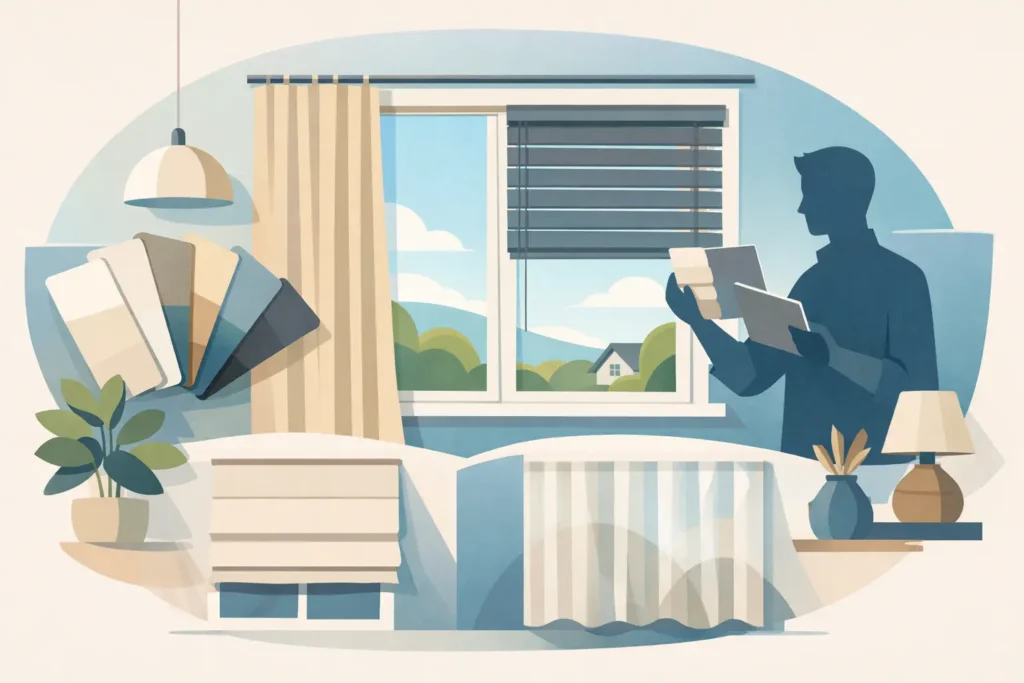
A window treatment can look perfect in a showroom and feel completely wrong once it is mounted in your home. Afternoon sun may hit harder than expected, a beautiful fabric may offer too little privacy, or an outside mount may make a small window feel smaller. This guide to custom window coverings helps you make choices based on how your rooms actually look, feel, and function – not just what catches your eye in a sample book.
For homeowners and office decision-makers in Los Angeles and Orange County, the right treatment often has to do several jobs at once. It should support the room’s style, manage bright California light, provide the needed privacy, fit accurately, and hold up to daily use. Custom options make that balance much easier because they are selected and measured for your specific windows.
Start With What Each Window Needs to Do
Before choosing a material, identify the main purpose of each covering. A bedroom facing a neighboring home has different needs than a living room with a view, and a west-facing office has different light concerns than a shaded dining room. Treating every window alike can make the selection process simpler, but it may leave some rooms less comfortable.
Think about privacy, glare, insulation, room darkening, visibility, and ease of use. In a family room, you may want to soften harsh sunlight without losing the view. In a nursery or media room, stronger room-darkening performance may matter more. In a bathroom, moisture resistance and privacy usually lead the decision.
It also helps to consider when the room is used. A bright kitchen may need adjustable light through the day, while a guest room may only need occasional privacy. These details guide the product choice better than color alone.
Light control is not the same as room darkening
Many homeowners want more control over sunlight but do not necessarily want a dark room. Light-filtering shades diffuse daylight and reduce glare while keeping the space bright. Solar shades can help preserve a view while cutting down on heat and screen glare. For rooms where sleep or movie viewing is the priority, blackout or room-darkening materials offer stronger coverage.
Even then, there is a trade-off. A blackout shade can greatly reduce incoming light, but small light gaps may remain around the edges depending on the mounting style and window shape. A professional consultation can help determine whether a side-channel system, layered treatment, or a different product is appropriate for the level of darkness you want.
Choose the Covering Type Before the Details
The best custom window covering is not always the most elaborate one. It is the one that suits the window, the room, and the way you live. Blinds, shades, and shutters each offer distinct advantages.
Blinds for adjustable light and a clean profile
Horizontal blinds allow you to tilt slats for privacy and directional light control. They work well in kitchens, offices, and rooms where you want to adjust the amount of light without fully raising the treatment. Materials matter: faux wood can be a practical choice in areas exposed to moisture, while real wood offers a warm, natural finish for dry living spaces.
Blinds provide flexibility, but their individual slats require more routine dusting than a simple roller shade. They can also look busier than a shade in a minimalist room. The right slat size, finish, and mounting method can keep the final look intentional rather than cluttered.
Shades for softness and versatility
Shades are a strong choice when you want a more streamlined appearance or a softer layer of color and texture. Roller shades are simple and modern. Cellular shades can help with insulation and are especially useful on windows that receive intense sun. Roman shades bring a more tailored, decorative look to bedrooms, dining rooms, and formal living areas.
Fabric selection deserves careful attention. A pale shade may look almost white in a sample but take on a warmer or cooler tone once light passes through it at home. Texture can also affect the mood of a room. A smooth woven fabric feels different from a linen-like material, even when the colors are similar.
Shutters for structure and long-term appeal
Plantation shutters create a finished, architectural look that suits many Southern California homes. Their adjustable louvers offer privacy and light control, and their solid frame makes them feel like a permanent part of the window. They are especially popular in living rooms, bedrooms, and street-facing spaces where curb appeal matters.
Shutters require a larger upfront investment than many blinds or shades. They are also a more defined style choice, so they may not be the first choice for every contemporary or fabric-forward design. Still, for homeowners who value durability, clean lines, and a custom-built appearance, they can be an excellent fit.
A Guide to Custom Window Coverings Should Include Measurement
Accurate measurement is what separates a custom-fit treatment from a product that simply covers a window. Window openings are rarely as uniform as they appear. Drywall, trim, tile, handles, and window depth can all affect whether a treatment should be mounted inside or outside the frame.
An inside mount sits within the window opening and creates a neat, built-in appearance. It can be ideal when the frame is deep enough and you want to showcase attractive trim. An outside mount is installed above or around the opening. It can make a window appear larger, cover shallow or uneven frames, and improve light coverage in some situations.
Measurements should account for more than width and height. The installer needs to check for obstructions, clearance around handles, the location of window cranks, and how the treatment will stack when open. On wide windows, the size and position of a center gap may matter. On doors, clearance for opening and closing is essential.
This is why in-home measurement is valuable. Rather than trying to translate rough measurements into an online order, you can evaluate the product at the window itself and avoid costly fit issues later.
Make Color and Material Decisions in Your Own Light
A mobile showroom gives you a practical advantage: you can see samples against your wall color, flooring, furniture, and natural light. This is especially helpful in Los Angeles homes, where strong sun can dramatically change the appearance of white, gray, beige, and wood-tone materials.
Start by deciding whether the covering should blend in or become a design feature. Matching the treatment closely to wall color creates a calm, unified look. Selecting a contrasting tone or textured fabric adds dimension and can give a simple room more character. For homes with several connected spaces, repeating a related material or color family can create visual continuity without making every room identical.
Do not overlook the exterior view. In many neighborhoods, street-facing windows benefit from a consistent exterior appearance. Shutters, neutral shades, and coordinated blind colors can look polished from outside while still allowing each interior room to have its own personality.
Consider Motorization for Hard-to-Reach or High-Use Windows
Motorized window coverings are often chosen for tall windows, large walls of glass, and spaces where several treatments are raised or lowered every day. They can also be a convenient option for bedrooms, media rooms, and homes where safety is a priority. Cordless and motorized designs reduce the need for dangling cords and offer a cleaner appearance.
The decision depends on how often the treatment will be adjusted and whether convenient control will genuinely improve daily use. Motorization adds cost, and the appropriate power option depends on the product and location. For a single low-use window, a standard cordless lift may be all you need. For multiple high windows or a frequently used great room, motorization can be a worthwhile comfort upgrade.
Plan for Professional Installation and Long-Term Use
A quality product can still underperform if it is installed incorrectly. Treatments must be level, securely mounted, aligned with the window, and tested for smooth operation. Professional installation is particularly valuable for shutters, motorized shades, oversized treatments, and windows with unusual trim or limited mounting space.
Ask how the treatment will operate after installation, how to clean it, and what maintenance it may need. Most blinds and shutters benefit from regular light dusting. Fabric shades may need gentle vacuuming with a brush attachment or spot cleaning according to the manufacturer’s instructions. Choosing a material that fits your household routine is just as useful as choosing one that fits your design plan.
Blinds by Design brings the consultation, product samples, measurement, and installation process together, so you can compare options with experienced guidance in the room where they will be used. A free in-home consultation is a practical next step when you are ready to see how custom treatments can improve the comfort, privacy, and finish of your space.