
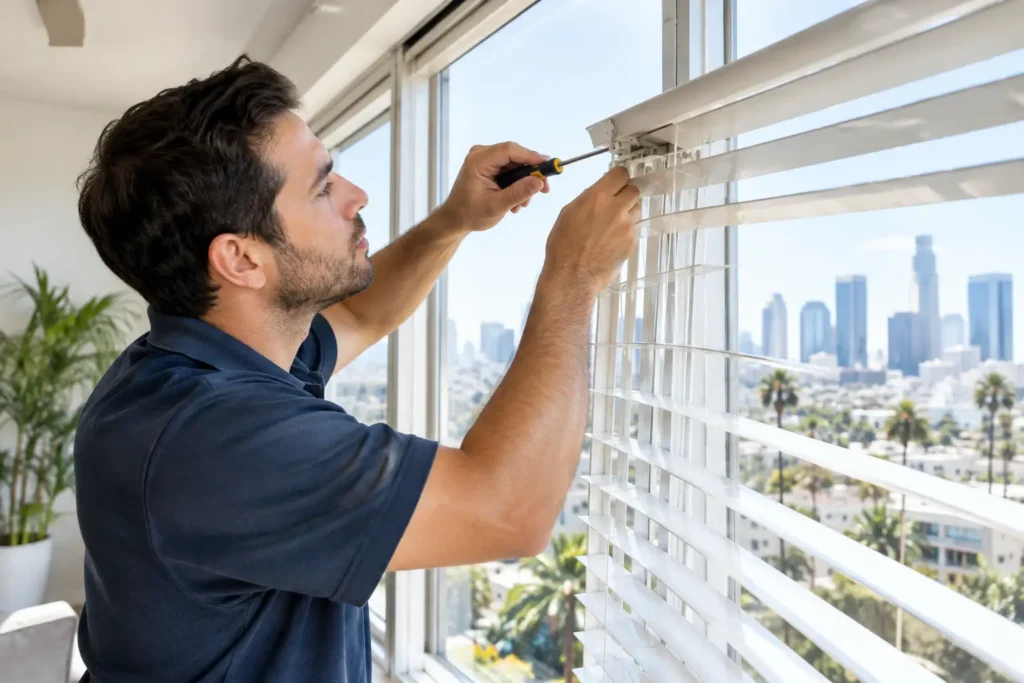
A blind that will not raise, a cord hanging loose, or slats that no longer tilt can make an otherwise finished room feel unfinished. For Los Angeles homeowners, blind repair cost is usually less about one flat price and more about the style of blind, the failed part, and whether the treatment can be repaired safely without compromising its fit or appearance.
A quick fix may be worthwhile for a quality custom blind with years of service left. In other cases, especially when several components are worn or the blind is outdated, replacement can be the more practical investment. Understanding the difference helps you make a confident decision before scheduling service.
What affects blind repair cost?
The first factor is the type of window treatment. A simple cordless faux wood blind with a damaged valance clip is very different from a large wood blind with a failed lift mechanism. Motorized blinds, vertical blinds, cellular shades, and woven shades each use different components and require different levels of troubleshooting.
The repair itself also matters. Replacing a wand, clip, bracket, or individual slat is typically straightforward if a matching part is available. Restringing a blind, repairing a tilt gear, replacing a lift mechanism, or correcting a damaged headrail takes more time and precision. Larger treatments can add labor because they need to be removed, tested, adjusted, and reinstalled carefully.
Part availability is another variable that homeowners often do not see at first. Some manufacturers support older products with replacement components, while others discontinue specific colors, mechanisms, or motor systems. A professional can identify the product, inspect its condition, and determine whether an appropriate part can be sourced. When an exact match is unavailable, a repair may still restore function, but the appearance or operation may not be identical.
Location and access can affect the service as well. Treatments installed over tall windows, behind furniture, or in hard-to-reach areas may require more setup time. For offices, repairs may need to be scheduled around business hours or completed in phases to avoid disrupting the workspace.
Typical blind repair cost by problem
Most repairs fall into a few common categories. The figures below are general planning ranges, not a substitute for an in-home assessment. The final price depends on the treatment, the needed parts, and the condition of the full system.
Broken cords, strings, and lift systems
A frayed cord or a blind that will not lift evenly often points to a damaged lift cord, ladder string, cord lock, or internal lift component. Basic cord work may be a modest repair, while a complete restringing or lift mechanism repair commonly costs more because the blind must be taken apart and rebuilt correctly.
For a well-made horizontal blind, this work can be worthwhile when the slats, headrail, and mounting hardware remain in good shape. If strings are failing on several blinds installed at the same time, it is smart to evaluate their overall age before repairing each one individually.
Tilt mechanisms and wands
When slats will not rotate for privacy or light control, the issue may be a broken tilt wand, worn tilt gear, or disconnected mechanism inside the headrail. Replacing an exterior wand is often one of the simpler repairs. A failed internal mechanism is more involved, especially on wood and faux wood blinds with heavier slats.
Tilt repairs are often worth considering when the blind still opens and closes smoothly and the slats are intact. They restore one of the main reasons people choose blinds in the first place: easy control over sunlight and privacy.
Damaged slats, clips, and brackets
A bent aluminum slat, cracked faux wood slat, missing vertical vane, or broken mounting bracket may seem minor, but it can affect how the entire treatment hangs and operates. Individual parts are often affordable when they can be matched. The challenge is finding the correct size, color, profile, and manufacturer-specific design.
If damage is isolated to one or two pieces, repair is usually sensible. If many slats are warped, faded, or cracked from years of heat and sun exposure, replacement may produce a better-looking result and prevent repeated service calls.
Cordless and motorized blind repairs
Cordless systems have fewer visible cords but still rely on internal springs, tension components, and lift mechanisms. When a cordless blind will not stay in position or rises unevenly, the repair can require specialized parts and careful adjustment.
Motorized blinds add convenience, but their diagnosis is more technical. The concern may be a depleted battery, charger issue, remote programming problem, damaged motor, or communication issue with a smart-home system. Some issues are quick to resolve; others require replacing a motor or control component. Before assuming the motor has failed, a technician should check power, settings, limits, and the treatment’s physical operation.
Repair or replace: how to decide
Cost matters, but it should not be the only deciding factor. Start with the age and quality of the window treatment. A custom blind that fits the window precisely and complements the room may justify a more involved repair. This is especially true for larger or unusual window sizes, where replacing a single treatment can be more expensive than restoring the one already in place.
Next, look at the condition beyond the immediate problem. A blind with one broken cord but clean slats, a straight headrail, and dependable mounting hardware is a strong repair candidate. A blind with damaged cords, brittle slats, fading, warped material, and loose brackets may be nearing the end of its useful life.
Safety should also guide the decision. Older corded blinds can create concerns in homes with young children or pets. Replacing them with cordless blinds or custom shades can improve safety while updating the room’s style. For bedrooms, living rooms, and street-facing windows, a new treatment may also offer better light filtering, blackout performance, insulation, or privacy than the original product.
Why professional assessment can save money
It is tempting to order a replacement part online and attempt a repair yourself. For a loose bracket or a simple wand replacement, that can be reasonable. The risk increases when the repair involves internal mechanisms, tensioned cords, heavy blinds, or motorized components. An incorrect repair can leave the blind uneven, damage the headrail, or create an installation problem that costs more to correct later.
Professional service begins with identifying what has failed and whether the rest of the treatment is worth preserving. It also avoids a common frustration: purchasing a part that looks similar but does not fit. Accurate measuring, part matching, removal, adjustment, and reinstallation all make a difference in how the blind performs after the repair.
For homeowners managing multiple windows, an appointment can be especially useful. Rather than treating every issue separately, you can compare repair options across the home and prioritize the rooms where privacy, sun control, or appearance matters most.
How to prepare for a repair estimate
A few details will help make your estimate more accurate. Note whether the treatment is a horizontal blind, vertical blind, shade, shutter, cordless system, or motorized product. Take photos of the full window treatment, the damaged area, and any labels inside the headrail or on the back of the product.
It also helps to describe the symptom rather than guessing at the part. For example, explain whether the blind will not raise, will not stay raised, tilts unevenly, has a broken slat, or has stopped responding to its remote. Clear information lets a specialist arrive better prepared to assess the work.
If replacement becomes the better choice, ask to see options in the actual room. Light, wall color, furniture, and window shape all influence which material and opacity will feel right. A mobile showroom makes it easier to compare styles where they will be used instead of relying on a small sample under store lighting.
A repair should give you dependable function, not merely postpone the next problem. Blinds by Design can evaluate your existing treatments, explain the practical options, and help you decide whether a repair or a custom replacement best suits your space, budget, and daily needs.