
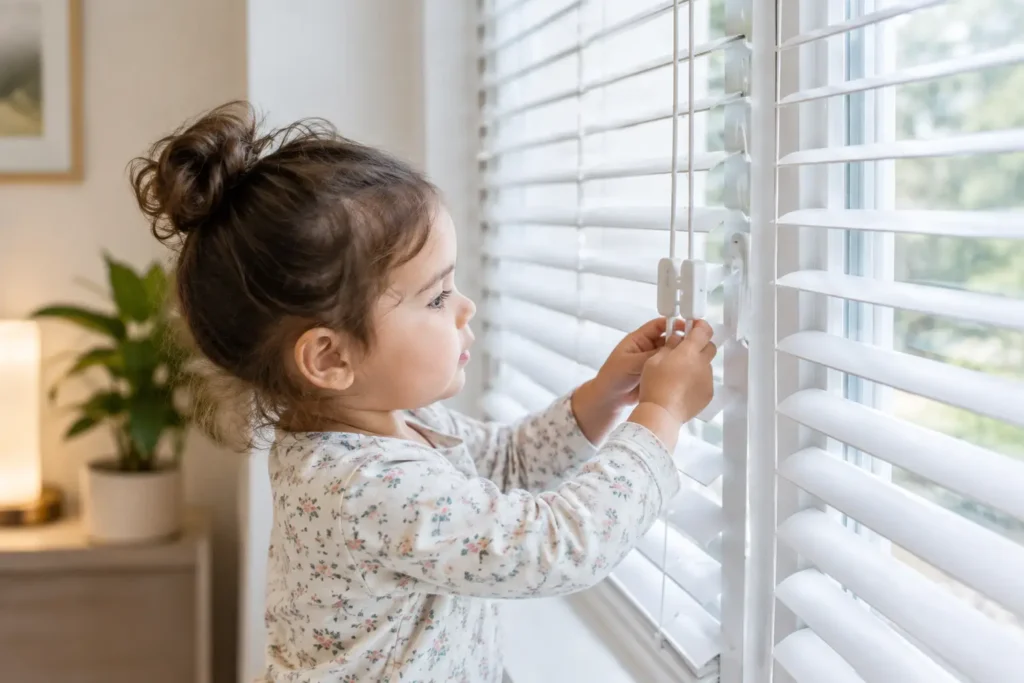
A window treatment can make a room feel finished, but for families with babies, toddlers, or visiting grandchildren, safety has to come before style. Learning how to childproof window blinds starts with recognizing that accessible cords can create a serious strangulation hazard in seconds. The goal is not simply to move a cord out of sight. It is to choose, install, and maintain window coverings that eliminate or properly control potential hazards while still giving your home the privacy, light control, and design you want.
For many Los Angeles and Orange County homeowners, this is also the right time to replace older blinds that no longer fit the way their household lives. Modern cordless shades, shutters, and motorized treatments offer a cleaner look and fewer daily safety concerns than traditional corded products.
Why blind cords need your attention
The greatest concern with older blinds and shades is the looped operating cord. A child can become entangled in a cord loop, inner cord, or chain while playing near a window, climbing furniture, or reaching for something on the sill. Even a cord that appears high enough can become accessible when a child is standing on a bed, chair, bench, or toy storage unit.
This is why wrapping a cord around a hook or tucking it behind a valance should not be treated as a complete safety solution. It may reduce access at that moment, but it does not remove the underlying risk. Children grow, climb, and explore quickly. A safer plan combines the right product, correctly installed safety hardware, and thoughtful placement of furniture around every window.
Start by walking through each room at your child’s eye level. Check bedrooms, nurseries, playrooms, guest rooms, and living areas where children spend time. Look for dangling lift cords, continuous cord loops, bead chains, cords that can pull away from the wall, and furniture positioned directly beneath a window.
How to childproof window blinds with safer designs
The most reliable approach is to select window treatments with no exposed operating cords. This choice removes the daily need to tie up or monitor cords and gives the window a more polished, uncluttered appearance.
Choose cordless blinds or shades
Cordless blinds and shades raise and lower by gently lifting or pulling the bottom rail. They are available in many styles, including cellular shades, roller shades, Roman shades, and certain horizontal blinds. Because there is no hanging lift cord, they are often a practical choice for children’s rooms and busy family spaces.
That said, cordless does not mean every product operates the same way. Some shades are best for windows that are easy to reach, while others may be less convenient for tall or wide openings. During an in-home consultation, it helps to test the lift action and consider who will use the window treatment most often.
Consider shutters with hidden tilt options
Plantation shutters are naturally well suited to family homes because they do not rely on hanging lift cords. Depending on the design, louvers can be adjusted with a discreet tilt bar or a hidden tilt system. Shutters also provide durable light control and privacy, making them a strong option for bedrooms, street-facing rooms, and homes where a long-lasting built-in look is the goal.
The trade-off is that shutters are a more permanent investment than many shades. Custom measuring matters, particularly for older homes with windows that are not perfectly square.
Use motorized treatments for hard-to-reach windows
Motorized blinds and shades are another excellent cordless solution. They can be operated by remote, wall control, or compatible smart-home controls, depending on the product selected. They are especially useful for high windows, wide sliding doors, or rooms where opening and closing several shades manually would be inconvenient.
For child safety, keep remotes stored out of reach and choose wall controls installed at an appropriate height. A motorized shade should still be professionally fitted and programmed so it operates smoothly without rubbing, catching, or stopping unevenly.
Select wand controls when cordless is not the only need
Some horizontal blinds use a wand rather than a tilt cord to open and close the slats. A wand can be a safer alternative for tilt operation because it avoids a dangling cord, but it does not automatically make a blind child-safe if the blind still uses a lift cord. Review every operating component, not just the most visible one.
Make existing corded blinds safer right now
Replacing older treatments is often the best long-term option, but homeowners may need immediate steps while they plan a renovation or select new window coverings. In that case, use approved cord-safety devices designed for the specific blind or shade you own.
Continuous-loop cords and bead chains should be secured with a properly installed tension device. This device keeps the loop taut and close to the wall rather than hanging freely. It must be firmly anchored to the window frame, wall, or trim according to the product instructions. A loose tension device does not provide dependable protection.
For blinds with separate lift cords, use a cord cleat or cord wrap mounted high enough to keep cords fully out of a child’s reach. Wrap the cord securely every time the blind is adjusted. Cord stops may also help limit how far a cord can be pulled through the mechanism, but they are not a substitute for keeping the cord inaccessible.
Avoid improvised fixes such as cutting cords, tying large knots, using tape, or relying on a temporary clip. Altering a blind without understanding its mechanism can make it operate poorly, create new loops, or damage the treatment. If a blind is worn, difficult to raise, or missing safety components, replacement is generally the safer choice.
Look beyond the blinds themselves
Window-treatment safety works best when the entire area around the window is considered. Move cribs, beds, changing tables, chairs, toy chests, and bookcases away from windows with blinds or shades. A child should not be able to reach the treatment by climbing on nearby furniture.
Keep window sills clear of tempting objects, including toys, decorative items, and electronics. If a child can see something interesting near a window, they are more likely to climb toward it. This is also a good time to inspect the window for fall safety. Window screens are not designed to prevent falls. Depending on the window and room, stops, guards, or other safety measures may be appropriate.
If you have older children, explain that blinds and cords are not toys. Still, product choice should never depend on a child remembering a rule every day. Passive safety features, such as cordless operation and securely installed hardware, offer more dependable protection.
Professional measurement and installation make a difference
A child-safe product only performs as intended when it is properly measured and installed. Brackets need to be secure, shades need sufficient clearance to operate correctly, and any required tension devices or controls need to be placed in the right location. This is particularly relevant for large windows, specialty shapes, recessed openings, and treatments installed near doors or furniture.
Custom window treatments also let you balance safety with the details that matter in your home. You may want blackout shades for a nursery, moisture-resistant shutters in a bathroom, solar shades that soften intense afternoon sun, or layered treatments that provide both privacy and a finished designer look. The safest option is not always one product for every room. It depends on the window, how the room is used, and the age of the children in the home.
At Blinds by Design, an in-home consultation makes it easier to compare cordless, shutter, and motorized options in the actual space. Seeing fabrics, colors, and operating systems at your window helps you make a choice that feels right for your home instead of settling for a one-size-fits-all solution.
Recheck safety as your household changes
Childproofing is not a one-time task. Revisit your windows when a baby starts crawling, when a toddler begins climbing, when furniture is rearranged, or when family members move into a new home. Check that cord devices remain secured, that shades operate as they should, and that no new furniture has created access to a window.
A well-chosen window treatment should make your home feel more comfortable, not add another safety concern to manage. If you are updating a nursery, remodeling a family room, or replacing older corded blinds, a free professional consultation can help you choose a custom solution that supports both your style and your peace of mind.