
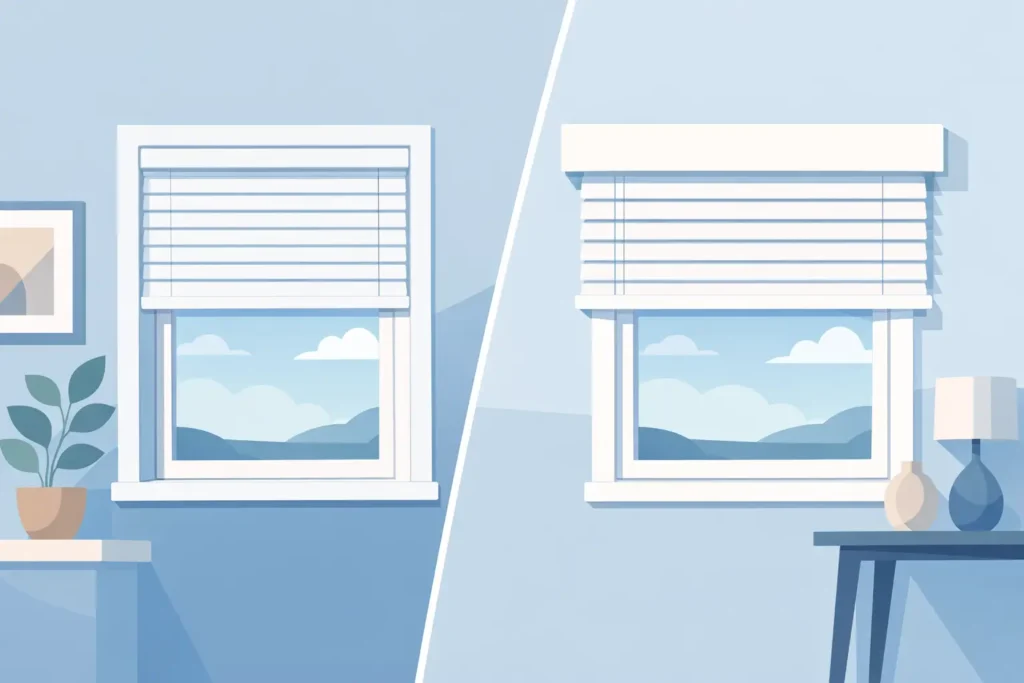
A window treatment can look perfect in the showroom and still feel wrong once it is installed. In most cases, the issue is not the color, fabric, or material. It is the mount. When homeowners compare inside mount vs outside mount, they are really deciding how the treatment will sit on the window, how much light it will block, and how finished the room will feel.
That choice sounds simple, but it affects more than appearance. It changes privacy, function, clearance, and even whether a product can be installed at all. If you are ordering custom blinds, shades, or shutters, this is one of the first decisions worth getting right.
Inside mount vs outside mount: what is the difference?
An inside mount means the blinds, shades, or shutters are installed within the window frame. The treatment sits inside the opening, which creates a clean, tailored look. Many homeowners prefer this option when they want the trim to remain visible and the window to feel neat and architectural.
An outside mount means the treatment is installed on the wall, molding, or area above and around the window frame. Instead of fitting within the opening, it overlaps it. This often makes the window look larger and can improve light control and privacy because the treatment covers more of the surrounding area.
Neither option is automatically better. The right choice depends on your window depth, your design goals, and how you use the room.
When an inside mount makes the most sense
Inside mount is popular for a reason. It gives blinds and shades a custom, built-in appearance that works especially well in updated homes, offices, and rooms with attractive window trim. If your goal is a streamlined look, this is usually the first option to consider.
Inside-mounted treatments also pair well with layered designs. Because the treatment sits within the frame, you can add drapery panels on the outside without making the window feel bulky. That is a common choice in bedrooms, living rooms, and formal spaces where softness and structure both matter.
There is also a practical benefit. If you have a window sill you want to keep usable for plants, decor, or everyday function, inside mount generally keeps the treatment out of the way more than an outside mount would.
The trade-offs of inside mount
The clean look comes with some limits. The biggest one is light gap. Since the treatment sits inside the frame, a small amount of space remains at the sides. With blinds and many shades, that means some light can filter in around the edges. In a living room, that may not matter much. In a bedroom, media room, or nursery, it can be more noticeable.
Window depth also matters. Some products require a minimum depth for flush mounting. If the frame is too shallow, the treatment may protrude or may not qualify for an inside mount at all. This is especially important with shutters and certain motorized products.
Inside mount can also highlight imperfections. If your window opening is out of square, which is common in older homes, the fit may not look as even as expected. Custom measuring helps, but a narrow or uneven frame can still affect the final appearance.
When an outside mount is the better choice
Outside mount is often the smarter option when function leads the decision. If you want better room darkening, improved privacy, or coverage for a window with limited depth, outside mount solves problems that inside mount cannot.
Because the treatment extends beyond the opening, it blocks more light along the edges. That makes it a strong choice for bedrooms, conference rooms, street-facing windows, and any space where reducing glare is important. It can also help conceal uneven window frames, damaged trim, or older openings that are not ideal for a precise inside fit.
Outside mount can visually change the room too. Installed slightly above and wider than the frame, a shade or blind can make a small window appear larger and taller. In homes where the windows feel undersized, this can improve the overall balance of the wall.
The trade-offs of outside mount
Outside mount is more forgiving, but it creates a different look. The treatment becomes a stronger visual feature, which may or may not be what you want. If your home has beautiful trim you want to show off, covering part of it with an outside mount may feel like a compromise.
Depending on the product, outside mount can also project farther from the wall. That may matter near doors, in tight hallways, or in spaces where furniture sits close to the window. For frequently used windows, you also want to think about access. If the treatment overlaps the frame significantly, opening the window may feel less convenient.
Inside mount vs outside mount for light control and privacy
If your top priority is light blocking, outside mount usually has the advantage. It covers more area and reduces the side gaps that let daylight in. That does not mean inside mount performs poorly, but it does mean expectations should be realistic, especially with blackout shades. A blackout fabric can still allow light around the edges if the shade is mounted inside the frame.
For privacy, the same rule often applies. Outside mount generally offers fuller coverage. This can be helpful for ground-floor rooms, bathrooms, offices, and homes close to neighboring properties.
That said, privacy is not only about mount type. Product selection matters too. A solar shade, wood blind, roller shade, or plantation shutter will all behave differently. The mount helps shape the result, but the treatment itself still plays a major role.
Style matters, but so does the window itself
Many homeowners start with aesthetics, and that makes sense. Inside mount tends to feel crisp, minimal, and custom. Outside mount tends to feel more dramatic, more decorative, or more accommodating depending on the product and installation height.
Still, the window should guide the decision. A deep, well-finished frame often invites an inside mount. A shallow frame, arched trim detail, or uneven opening may point toward outside mount. Sliding doors, French doors, and extra-wide windows also introduce special considerations, since clearance and operation become more important.
This is where in-home measuring makes a real difference. Two windows that look similar at a glance can have very different depths, obstructions, or framing issues once measured properly.
Choosing the right mount for shutters, blinds, and shades
Different products respond differently to mounting style. Shutters often look especially polished as an inside mount when the window has enough depth and the frame is square. But outside mount shutters can be the better answer when the opening is shallow or the trim needs to be covered.
Blinds are flexible and can work well with either mount. Inside mount blinds keep the look clean, while outside mount blinds can improve coverage and reduce light gaps.
Shades vary the most. Roller shades, cellular shades, Roman shades, woven wood shades, and motorized styles each have their own space needs and stacking behavior. A Roman shade mounted outside may look intentionally soft and decorative, while a cellular shade mounted inside may feel compact and understated. The best choice depends on both the room and the product.
Why professional measuring matters
Inside mount vs outside mount is not something to guess at from online photos. A fraction of an inch can affect fit, operation, and appearance. Measuring for inside mount requires accuracy at multiple points because window openings are often not perfectly consistent. Outside mount requires careful planning too, especially when accounting for overlap, height placement, and nearby trim or molding.
Professional guidance also helps you weigh the real-life trade-offs. A homeowner may prefer the look of an inside mount, only to find that the window depth is too shallow for the product they want. Or they may assume outside mount will look bulky, when in fact it creates the cleaner finished result in that particular room.
That is why a full-service process matters. With custom window treatments, the goal is not just to pick a style you like. It is to choose a solution that fits the space, works smoothly, and still looks right years from now.
For Los Angeles-area homeowners and business owners, that often comes down to seeing samples in the room, checking the actual window conditions, and getting recommendations based on how the space is used. At Blinds by Design, that hands-on approach helps remove the guesswork before anything is ordered.
If you are deciding between inside mount and outside mount, the best choice is the one that matches your window, your priorities, and the way you want the room to function. A clean look is great. Better privacy is great too. The right answer is the one that gives you both where it matters most.