
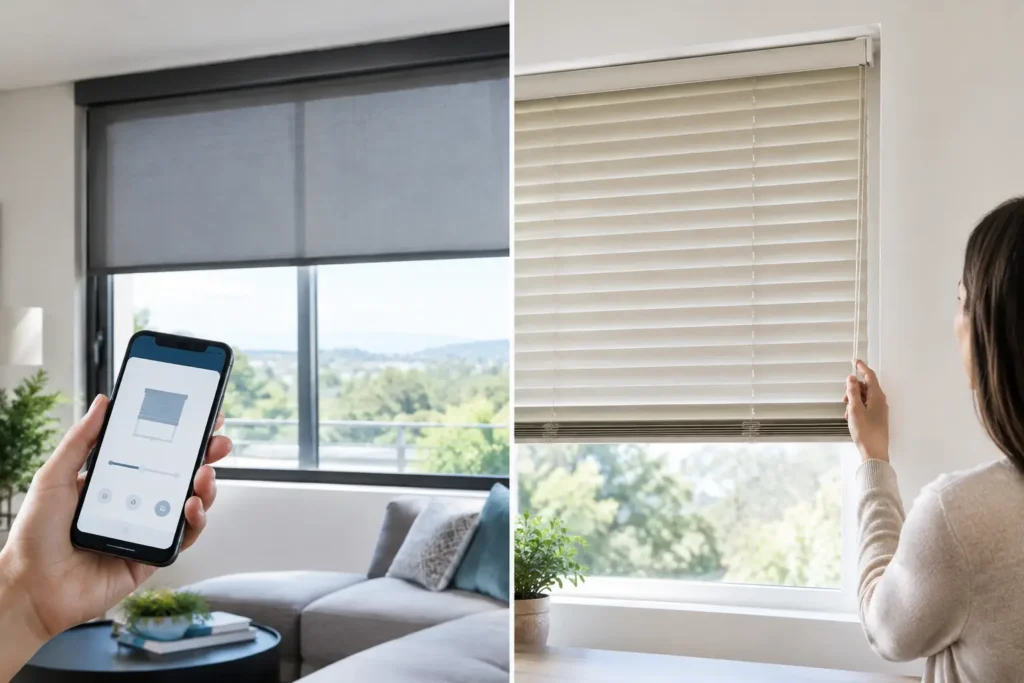
A west-facing living room can be comfortable at breakfast and nearly unlivable by late afternoon. For many Los Angeles homeowners, the choice between smart shades versus manual shades comes down to that daily reality: how much light enters, when it enters, and how easy it is to manage without interrupting work, family time, or a quiet evening at home.
Both options can be beautiful, custom-fitted, and highly effective. The better choice depends less on what is newest and more on your windows, routines, budget, and expectations for convenience. A well-chosen manual shade can be an excellent long-term solution. A smart shade can make difficult windows and busy schedules much easier to handle.
Smart Shades Versus Manual Shades: The Practical Difference
Manual shades are operated by hand, typically with a cordless lift system, a continuous-loop chain, or a simple pull mechanism. They are familiar, straightforward, and available in nearly every shade style, including roller shades, Roman shades, cellular shades, woven woods, and sheer shades.
Smart shades use a motor to raise, lower, tilt, or position the shade. Depending on the system, operation may be handled with a remote, wall control, phone app, timer, voice assistant, or integrated home automation system. Some models are hardwired, while others use rechargeable battery power.
The fabric, color, opacity, and custom fit matter just as much as the operating method. A motorized blackout roller shade and a manually operated blackout roller shade may provide similar room-darkening performance. The real difference is how consistently and conveniently you can use them.
When Smart Shades Make Sense
Smart shades are especially useful when operating a window treatment manually would be inconvenient, repetitive, or unsafe. High clerestory windows, large multi-panel doors, windows behind furniture, and hard-to-reach areas are common examples. If you need a step stool to adjust a shade, motorization is often worth considering.
They also work well for homes where light control changes throughout the day. In Southern California, direct sun can create glare on televisions and computer screens, heat up a room, and fade flooring or furnishings. Setting shades to close during the strongest afternoon light can improve comfort without requiring someone to remember each day.
Convenience for busy households
For a household with children, pets, remote-work schedules, or frequent travel, smart shades offer more than a novelty feature. A grouped control lets you adjust several shades at once. Rather than walking room to room before leaving the house, you can lower a bank of shades with one command.
Scheduled operation can also support a more natural daily rhythm. Bedroom shades may open gradually in the morning, while living room shades close at a set time to reduce late-day glare. The details vary by product and control system, but the goal is simple: your window coverings respond to the way you actually use your home.
A cleaner look for larger windows
Motorized shades can reduce the need for visible cords and chains, which is valuable in clean, modern interiors. They are also a practical choice for wide windows where a manually operated shade may feel heavy or require more effort to lift evenly.
That said, motorization does not replace thoughtful design. The right fabric openness, lining, color, and mounting style still determine whether the finished treatment complements the room and provides the privacy you expect at night.
Why Manual Shades Still Have a Strong Case
Manual shades are not a compromise by default. For accessible windows that are adjusted occasionally, they are often the most practical and cost-conscious option. A quality cordless manual shade is easy to use, visually clean, and dependable without batteries, charging, or programming.
They are particularly well suited to guest rooms, secondary bedrooms, smaller windows, and spaces where you generally set the shade once and leave it in place. If a shade is primarily there for privacy and is only opened in the morning and closed in the evening, the added cost of automation may not deliver enough daily value.
Lower upfront cost and simpler operation
The most obvious advantage of manual shades is price. Motorization adds the cost of the motor, power source, controls, and in some cases electrical work. For a home with many windows, that difference can be significant.
Manual systems are also easy for visitors, renters, and family members of all ages to understand immediately. There is no remote to locate, no app to configure, and no concern about whether a battery needs charging before guests arrive.
Fewer technology considerations
Smart shade systems are designed for everyday use, but they still involve technology. Battery-powered motors eventually need charging or battery replacement. Remote controls can be misplaced. App-based controls and home automation platforms may require setup or occasional updates.
For some clients, those considerations are minor compared with the convenience. For others, a simple cordless manual shade is exactly the low-maintenance solution they want. The right choice should feel easy after installation, not just impressive during a demonstration.
Compare Light Control, Privacy, and Energy Comfort
Whether a shade is smart or manual, performance starts with the product itself. A solar shade can reduce glare and preserve a view during the day, but it may offer limited nighttime privacy. A blackout shade can darken a bedroom, but small light gaps may remain around the edges depending on the installation and mounting style.
Cellular shades can add insulation and are often considered for bedrooms, offices, and rooms that get strong sun. Dual shades combine two fabrics, such as a light-filtering layer and a room-darkening layer, to give you more flexibility. Woven wood shades can bring warmth and texture, but may need a privacy or blackout liner depending on the room.
Smart control can improve how consistently you use these features. For example, a light-filtering shade scheduled to lower before direct sunlight reaches your dining room may help maintain a more comfortable temperature. But automation cannot make the wrong fabric perform like the right one. Product selection comes first.
Installation and Power Matter More Than Most People Expect
A custom measurement is essential for either option, particularly for large windows, French doors, bay windows, and outside-mount shades. Small measurement errors can affect light gaps, alignment, privacy, and the overall finished appearance.
With smart shades, the power plan should be decided early. Rechargeable battery systems are often a convenient option for existing homes because they avoid opening walls. Hardwired motors can be an excellent choice during a remodel or new construction, when electrical planning is already underway. Solar charging accessories may work well in certain sunny locations, but placement and product compatibility need to be evaluated carefully.
Professional installation is valuable because motorized shades must be mounted level, programmed correctly, and tested for smooth operation. It also helps ensure that paired shades align visually, especially across wide openings or multiple windows in the same room.
A Room-by-Room Approach Usually Works Best
You do not have to choose smart shades or manual shades for the entire home. Many homeowners get the best balance by using motorization where it changes everyday life and choosing manual operation where it does not.
Consider smart shades in the primary bedroom, media room, home office, large living area, or difficult-to-reach windows. Manual shades may be ideal for guest rooms, hall windows, laundry rooms, and other spaces with straightforward access. This approach can protect your budget while still bringing convenience to the areas where it matters most.
For offices, motorized shades can be especially helpful in conference rooms or shared workspaces where glare and privacy need to be adjusted quickly. A coordinated set of shades also gives the space a more polished, intentional appearance.
How to Decide With Confidence
Start by thinking about the moments that frustrate you now. Do you avoid adjusting certain shades because furniture blocks them? Does afternoon glare interrupt work or television? Do you want better privacy at night but forget to close the shades? Those are strong signs that smart operation may be worthwhile.
If your priority is a beautiful custom treatment with simple, reliable daily use, manual shades may meet your needs perfectly. If you want your shades to respond to a schedule, a command, or changing light conditions, smart shades are likely the better investment.
A free in-home consultation with Blinds by Design makes it easier to compare fabrics, operation styles, and power options in the actual rooms where they will be used. Seeing samples against your wall colors, furnishings, and natural light often clarifies the decision quickly. The best shade is the one that looks right, works reliably, and makes your home more comfortable every day.