
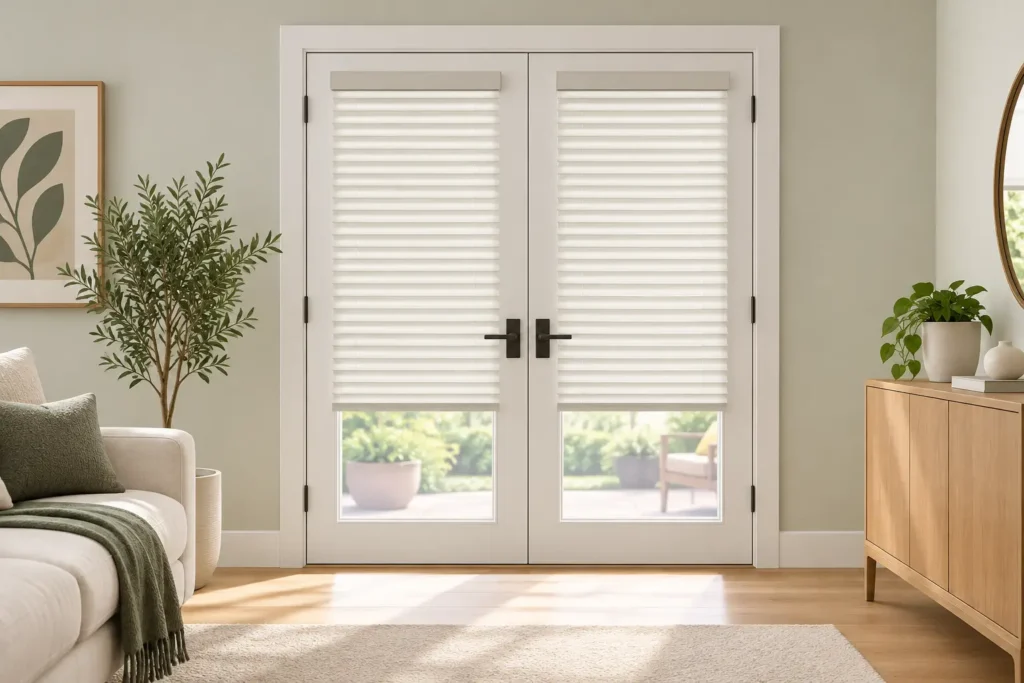
French doors bring in beautiful natural light, but they also create a window-treatment challenge that standard windows do not. The best blinds for french doors need to provide privacy and light control without interfering with handles, door movement, or the room’s overall design. A treatment that looks right in a showroom can feel awkward at home if it is too bulky, difficult to operate, or mounted without enough clearance.
For most homes, the right answer starts with a custom measurement and a close look at how the doors are used. Do they open to a patio? Are they in a bedroom where privacy matters after dark? Is glare on a nearby TV or dining table the bigger concern? Those details shape the best choice.
What French Doors Need From Blinds
Unlike a single stationary window, French doors are active surfaces. Each door may open independently, and hardware projects outward from the glass. Window treatments must stay secure as the door moves while leaving enough room for the handles and locks to work comfortably.
Door-mounted treatments are often the most practical approach. They move with the door instead of hanging in the way when someone goes outside. Mounting also needs to account for the narrow space between the glass and the handle. A professional measurement helps prevent a common problem: blinds that scrape the hardware, rattle when the door closes, or leave unwanted gaps along the edges.
Appearance matters, too. French doors are often a focal point in a living room, kitchen, bedroom, or office. The treatment should complement the door’s lines rather than cover them up with a heavy or poorly proportioned product.
The Best Blinds for French Doors by Priority
There is no single best option for every French door. The strongest choice depends on whether privacy, insulation, easy operation, a minimal look, or a specific design style comes first.
Cellular shades for privacy and energy efficiency
Cellular shades are one of the most versatile choices for French doors. Their honeycomb-shaped cells help reduce heat transfer, which can be especially valuable on sunny Los Angeles and Orange County exposures. They offer a softer appearance than traditional blinds while maintaining a clean, tailored profile.
For bedrooms and rooms facing close neighbors, consider light-filtering or blackout cellular shades. Light-filtering fabrics soften daylight and reduce visibility from outside during the day. Blackout options provide stronger room darkening, though small light gaps around the frame can still occur with any door-mounted treatment.
Cellular shades are a smart fit when comfort and privacy are priorities. The trade-off is that some fabrics can look more casual than wood or faux wood products, so color and texture selection make a difference in formal spaces.
Faux wood blinds for a classic, durable look
Faux wood blinds give French doors a familiar, architectural appearance and provide excellent control over light and privacy. Tilting the slats lets homeowners redirect harsh afternoon sun while still allowing some natural light into the room. Closing the slats provides a more private feel without needing to raise the blind.
They are particularly practical in kitchens, busy family spaces, and doors exposed to moisture or heat because faux wood resists warping better than many natural wood products. A custom-fit blind with a hold-down feature at the bottom helps keep the treatment stable when the doors open and close.
The main consideration is depth. Faux wood blinds are more substantial than shades, so proper clearance around door handles is essential. Selecting the right slat size and mounting configuration keeps the blind functional without making the door feel crowded.
Aluminum mini blinds for compact, budget-conscious control
Aluminum mini blinds remain a useful choice when clearance is tight or a slim profile is needed. Their narrow slats work well on doors with limited space between the glass and hardware. They offer adjustable light control, are easy to wipe clean, and tend to be a practical option for offices, rental properties, and utility areas.
Their simpler appearance may not suit every high-end interior, but the right finish can look crisp and intentional. For clients who need reliable privacy and function on a budget, custom aluminum blinds are often worth considering.
Roller shades for a clean, modern finish
Roller shades work well when the goal is a streamlined look with minimal visual interruption. Available in many fabrics, opacities, and colors, they can suit contemporary interiors, coastal-inspired spaces, and understated traditional rooms. When raised, they stack neatly at the top of the door. When lowered, they create a smooth panel across the glass.
Solar screen roller shades are useful on patio doors that receive intense sun. They reduce glare and heat while preserving some outward visibility during daylight. For nighttime privacy, however, a more opaque fabric is usually the better choice. People outside can often see into a lighted room through an open-weave solar fabric after dark.
Roller shades do not provide the same incremental light adjustment as slatted blinds. They are either raised, lowered, or positioned somewhere in between. That simplicity is ideal for some households and less convenient for others.
Roman shades for softness and decorative appeal
Roman shades can make French doors feel warmer and more finished, especially in bedrooms, dining rooms, and traditional living areas. They bring fabric texture, pattern, and color to a space while still fitting the door in a tailored way. Flat Roman shades offer a clean profile, while more structured styles add visual depth.
Because fabric shades can project farther from the door than slimmer products, careful measuring is essential. They are usually best for doors with sufficient handle clearance and homeowners who prioritize a softer decorative statement. Lined fabrics can improve privacy and light control, but they may also make the shade heavier to raise and lower.
Details That Make a Big Difference
The product is only part of the decision. Custom features determine how well blinds perform on a door day after day. Hold-down brackets or pins are often recommended for blinds and shades mounted directly to French doors. They keep the bottom rail in place so the treatment does not swing when the door moves.
Control placement also deserves attention. A wand can provide straightforward slat adjustment for blinds, while cordless lift systems create a cleaner look with fewer dangling cords near a frequently used doorway. Motorized shades may be a strong option for hard-to-reach doors or homes where convenient operation is a priority. The best solution should be easy for everyone in the household to use, not just attractive on installation day.
Color selection can either blend the treatment into the door or create a purposeful contrast. Matching white, off-white, or a warm neutral to the door trim often keeps the look light and classic. A darker blind or shade can frame the glass more dramatically and tie into flooring, furniture, or cabinet finishes. Viewing samples in the actual room is far more reliable than choosing from a screen, since sunlight can change how every color reads.
Should You Choose Blinds, Shades, or Shutters?
Blinds are often the best fit for homeowners who want adjustable light control and a traditional look. Shades are ideal when a slimmer profile, fabric softness, energy efficiency, or a modern finish is more important. Shutters can be beautiful on French doors, but they require enough mounting depth and careful planning around handles. Their solid construction makes them a premium, long-lasting option for the right door configuration.
A free in-home consultation makes this decision much easier. An experienced specialist can measure the glass, check handle clearance, show material samples in your lighting, and explain which options will stay secure as the doors move. This is particularly helpful when two French doors are not perfectly identical, as can happen in older homes or after remodeling.
Blinds by Design helps homeowners throughout the local area choose custom window treatments that fit both the doors and the way the room is used. Rather than trying to force a standard-size product onto an important architectural feature, start with a measured solution that gives you privacy, comfortable light, and a finish that feels made for your home.